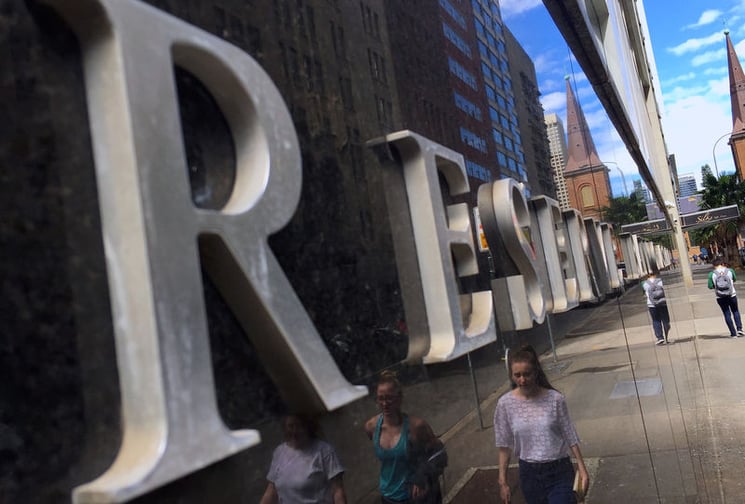
All eyes are on the Reserve Bank of Australia (RBA) this week as it gears up for its next decision on monetary policy. On the table: a potential third cut to the official cash rate (OCR), which currently sits at 3.85% after two reductions earlier in 2025.
Currently, the majority of the market — including all four of Australia's Big Four banks — expects the RBA to deliver a 25-basis-point rate cut on Tuesday.
"Inflation is moderating, and it should allow the RBA more comfort in achieving their dual mandate of price stability and full employment," Emma Lawson, fixed interest strategist in macroeconomics at global asset management giant Janus Henderson, told Australian Broker. "We saw at the last policy meeting that [the RBA] was more worried about the outlook for the economy and the higher levels of uncertainty. So that allows them — as inflation comes down — to be more confident in lowering the cash rate at the next meeting.
"And since that time, we have seen headline employment come off a little bit, and we've also seen the monthly CPI numbers come down to a more comfortable level, or certainly within target for the RBA," she continued.
In May, the Australian Bureau of Statistics (ABS) reported that the March quarter consumer price index — the nation’s key measure of core inflation — reached a three-year low, while unemployment held steady at a low 4.1%.
"The RBA can see that the household sector has been very soft and has taken a very precautionary approach to the rising real incomes by saving more rather than spending. And this has been holding the economy back," Lawson added. "There's a lot of uncertainty in the global outlook around the world, and there is a concern that the pickup in the domestic economy that we were expecting in 2025 cannot gain significant traction unless the RBA just allows a little bit more leeway in interest rates. So we expect that the lowering of inflation allows the RBA to lower the cash rate a little bit closer to neutral, rather than from its tighter setting."
Luke Yeaman, chief economist at Commonwealth (CBA), added in a note: "After a testing few years, where high inflation and interest rates hit consumers hard, the narrow path has been successfully landed. Inflation has been brought back under control, and this has been achieved without a significant rise in unemployment — a notable achievement. This should pave the way for two more 25bp rate cuts in July and August this year, taking the cash rate to a more neutral level."
Critics caution, however, that global uncertainty — from tariff tensions and Middle East unrest to recessionary fears — could stall the RBA’s rate cuts.
Adding to the complexity, US President Donald Trump recently announced a 20% tariff on Vietnamese exports to the US, a sharp drop from the initially proposed 46% during April's Liberation Day. While this won’t directly affect Australia, it will ripple through the region, including China — a key supplier for Australia — potentially driving up costs down the line.
"Global uncertainty is probably the main headwind in the Australian economy, and that has seemed to flow through to domestic conditions, including a stalling of the previous uptrend of consumer confidence, as well as some relatively weak consumer spending," said Adelaide Timbrell, senior economist at ANZ. The major recently updated its outlook and is now anticipating a 25 basis point reduction this month, a reversal from the previous forecast of August.
"It does seem that the average consumer is being a little more cautious than usual," Timbrell continued. "The household savings ratio is up and consumer spending growth is relatively weak. So that would point to a cautious consumer, and when we look at the domestic fundamentals in the economy, it's unlikely to be cautioned due to the labor market, because the unemployment rate is low and stable. It's unlikely to be about income, because average income growth is strong, or at least solid, and certainly stronger than inflation. So [reasons for a delay] are either a lingering impact of the cost-of-living increases we've seen over the last few years, or a result of the current global uncertainty."
Hobart-based economist Saul Eslake added that "uncertainty cuts both ways."
"There's uncertainty about whether the tariffs will bring higher inflation. But there's also uncertainty about whether they and other things will mean weaker growth," he said.
But Lawson added that cautious consumers might actually trigger deflation.
"When they're cautious and when they're not spending, there's low demand; firms will find it increasingly difficult to pass those costs on because there's no demand," she explained. "If firms raise prices, there'll be even less demand in a weak demand environment. So it's actually harder for them, and that's one of the reasons why you're seeing inflation come down. They can't pass on those price increases. So it's hard to get that inflationary spiral if there's very, very poor demand."