
Australian SMEs are rapidly adopting artificial intelligence, but a widening gap between digital leaders and laggards is reshaping which business clients are best placed to manage rising costs and tighter conditions, according to new NAB research.
NAB’s latest SME Business Insights report, based on a survey of around 670 non‑farm businesses, finds 42% of firms are already using AI, 44% are not, and a further 14% plan to adopt it. The landscape is now roughly balanced between firms that already use AI and those that do not, pointing to an economy in transition.
Data‑heavy sectors are setting the pace. Property services businesses report a 69% AI adoption rate, followed by finance and insurance at 64% and business services at 61%. These industries tend to have stronger digital foundations and large data sets, making it easier to embed AI for forecasting, compliance, and workflow automation – all factors that can support cash flow and serviceability for business owners with home or investment loans.
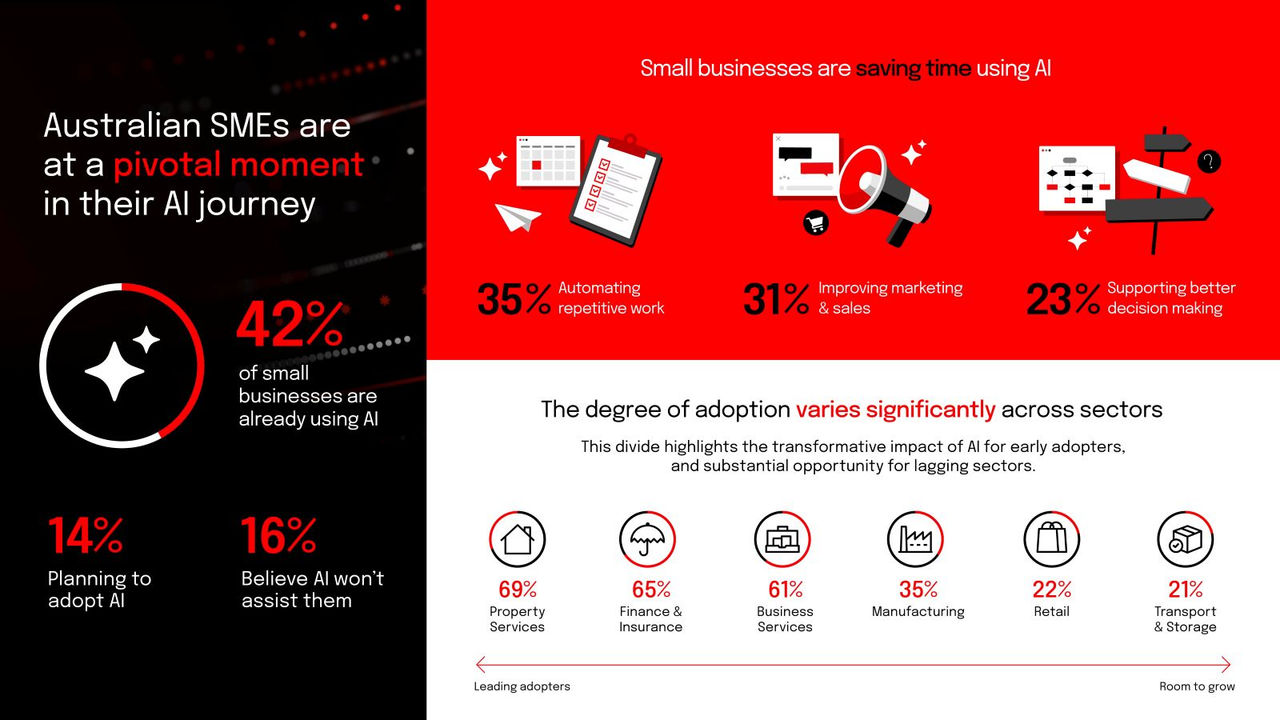
When asked where AI could help most, more than a third of SMEs pointed to automation of repetitive work, with around one‑third also highlighting marketing and sales‑related gains. Improving decision‑making and customer experience also rank highly, while a significant minority of firms still believe AI will not assist their business, underscoring ongoing scepticism and capability gaps.
Those abstract percentages are already visible in day‑to‑day SME operations. NAB Economics’ case studies show how this is playing out on the ground. Melbourne interior design and property services firm Design and Diplomacy uses AI to summarise complex documents, extract key risks and draft proposals, with director Tim Gauci describing it as “a productivity and thinking accelerator – not a substitute for professional judgement.”
“AI is quickly becoming part of the everyday toolkit for Australian businesses, but we’re still in the early chapters of what it can deliver,” said Dean Pearson, NAB’s head of behavioural and industry economics, adding that the real uplift will come as capability spreads beyond early adopters.
While property services, finance, and professional services are pulling ahead, sectors such as transport and storage and retail remain well behind, often constrained by tight margins, legacy systems, and lower digital maturity.
NAB’s case study of manufacturer Bella Manufacturing illustrates the upside. Director Andrew Blair says AI is helping shrink “boring, mundane tasks” so he can focus on customers and operations, after initially hearing only “horror stories” about the technology.
As AI tools become more common in SME operations, brokers who understand which industries are embracing them – and how that translates into cash‑flow management and risk – will be better placed to structure funding solutions for business owners. That insight will also help when advising first‑home buyers and property investors whose income depends on SME performance.Top of FormBottom of Form
As AI tools become more visible to consumers as well as SMEs, separate research from Great Southern Bank finds 69% of Australians who receive guidance from mortgage brokers or financial advisers consider that advice more valuable than AI, with just one in ten saying they would turn to AI first for major financial decisions.
Get the hottest and freshest property and mortgage news delivered right into your inbox. Subscribe now to our FREE daily newsletter.