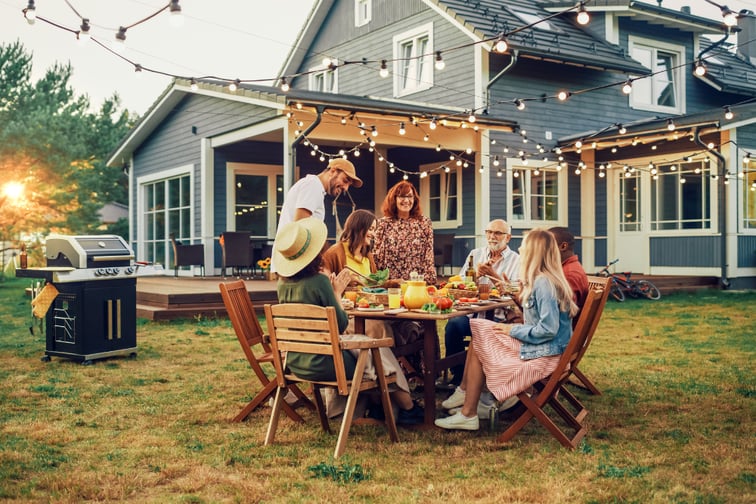
Families are increasingly turning to multi-generational living and shared ownership as a way to stay in the housing market.
The shift comes even as Australia’s homeownership rate of 62.7% remains close to the OECD average, with the traditional path from renter to mortgaged owner to outright owner having “elongated dramatically” as prices have surged and borrowing rules tightened.
New PropTrack data show online searches for “dual-occupancy” homes have jumped 385% in the past year, “dual-living” interest is up 100%, and “granny flat” searches have climbed 30%, with demand strongest in outer suburban markets, The Courier Mail reported.
PRD analysis suggests 10% to 15% of households nationwide already have multiple generations under one roof, a share expected to rise sharply over the next two decades. Separate ABS figures indicate that around one in five households are already multi-generational, and PRD projections suggest the proportion could lift to roughly one‑third of households by 2041.
PRD Real Estate chief economist Diaswati Mardiasmo says that while multi-generational living began as a cultural preference for many migrant families, it is now “no longer an option or preference, but a necessity” for a much broader group under financial pressure.
Mardiasmo also points to other drivers beyond pure affordability – including work‑life balance, family connection, caregiving, and preserving culture – which are encouraging families to see multi-gen living as a long‑term arrangement rather than a short‑term fix.
Switchboard Finance founder Nick Lim says what was once lifestyle-driven has become a hard-nosed affordability response.
“Five years ago, a family pooling households was usually a lifestyle decision,” Lim said. “Now it’s increasingly a mortgage serviceability decision. One income can’t carry a Brisbane home at current prices, but two or three can, and lenders are starting to assess those structures properly, where they used to penalise them.”
In Queensland alone, PRD research indicates 10% to 12% of households – up to 800,000 adults – are already living with family under the same roof, with the share projected to reach around one-third of households by 2041. That concentration is most visible in Brisbane’s outer suburbs and growth corridors where larger blocks make dual living and granny flat additions more feasible.
Lim notes that self-employed clients are prominent among new multi-gen applications. A café owner or tradie may struggle to qualify on their own under current income shading and mortgage rate buffers, but combining with an adult child in PAYG work or retired parents with an unencumbered home can transform their borrowing capacity. The property, he says, “becomes a vehicle for solving several problems at once”.
Two Red Shoes broker Rebecca Jarrett-Dalton is also seeing a “sharp rise” in shared ownership structures. New builds are increasingly designed with future multi-generational use in mind, incorporating pre-planned connecting doors, attached granny flats, and layouts that allow parts of the home to be semi-independent while still sharing land and loan obligations.
Traditional granny flats are also evolving into fully self-contained “granny pods” and dual-living designs with separate entries, private zones and independent facilities built in from the outset, while more dual duplexes and houses with separate entries are appearing as local and state policies support these forms.
Despite this evolution, multi-generational living remains heavily tied to detached housing, with about 89% of such households in standalone homes – highlighting the limits of many apartments and medium-density projects in accommodating extended families.
Get the hottest and freshest property and mortgage news delivered right into your inbox. Subscribe now to our FREE daily newsletter.