
Mortgage stress across Australia fell to its lowest level in three years in January, but Roy Morgan warns that rising interest rates and persistent inflation could reverse those gains in coming months.
Roy Morgan’s latest research shows 23.9% of mortgage holders – around 1.184 million people – were considered “at risk” of mortgage stress in January 2026, down 4 percentage points since August 2025 and the lowest share since January 2023.
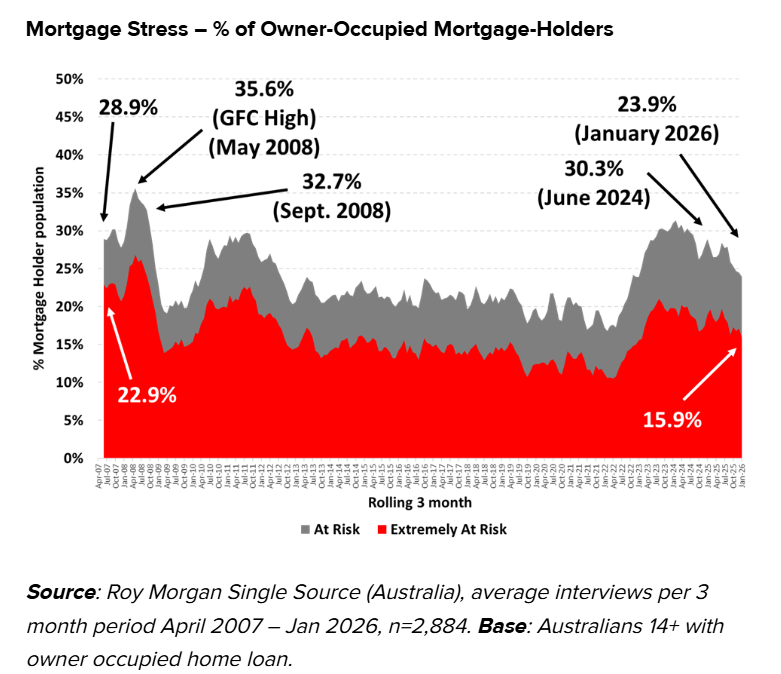
The decline reflects the Reserve Bank of Australia’s three rate cuts in 2025, which took the cash rate from 4.35% to 3.6% and eased pressure on variable mortgage rates.
Latest Canstar figures indicate the average variable rate for owner‑occupiers paying principal and interest is now about 6.17%, with only a small number of variable products still priced below 5.25%.
“The latest Roy Morgan data shows mortgage stress dropping to a three-year low in January 2026, down 0.6% points from December to 23.9% of mortgage holders (equivalent to 1,184,000) ‘at risk’,” Roy Morgan CEO Michele Levine (pictured) said.
However, she warned that inflation has re‑accelerated, with annual consumer price growth doubling from 1.9% in June 2025 to 3.8% by January, prompting RBA to lift the cash rate by 25 basis points in February to 3.85%.
With many lenders already lifting fixed and variable mortgage rates ahead of next week’s RBA board meeting, refinancing and rate risk are back in sharp focus for borrowers.
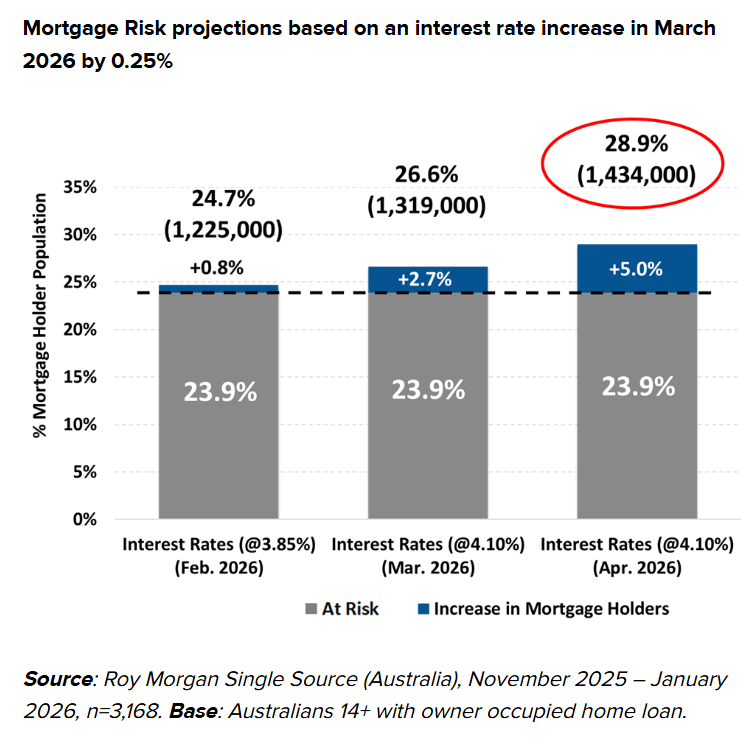
Roy Morgan has modelled the impact of further RBA tightening, forecasting that additional rate rises this year would push a significantly larger share of mortgage holders into the ‘at risk’ category.
“Following on from this interest rate increase Roy Morgan has modelled another potential interest rate increase in March of +0.25% to 4.1%. If the RBA does raise interest rates again the level of mortgage stress would rise to 1,319,000 (26.6% of mortgage holders) by March 2026 and increase even further to 1,434,000 (28.9% of mortgage holders) by April 2026,” Levine said.
Levine stressed that employment remains the biggest driver of mortgage stress, noting that more than one in five Australian workers are unemployed or under‑employed. And with household card spending at record highs and fuel costs rising in the wake of Middle East tensions, some borrowers’ budgets may already feel the strain of an extra rate rise even before the RBA’s next decision.
Get the hottest and freshest property and mortgage news delivered right into your inbox. Subscribe now to our FREE daily newsletter.