
The latest NAB Business Survey points to a gradual improvement in Australia’s economic backdrop, though the outlook for business investment remains uncertain.
“As highlighted in our coverage of the most recent national accounts, business investment was a key weak spot in the June quarter,” Westpac senior economist Mantas Vanagas (pictured) said in the bank’s latest insights.
“Although we expect that stronger household consumption and an uptick in domestic demand will eventually encourage businesses to invest with a higher degree of confidence, the timing of this process remains highly uncertain.”
He noted the August survey was “broadly consistent with a gradual underlying improvement in economic conditions.”
However, the improvement comes as inflation surprised on the upside in July, with Westpac’s Justin Smirk warning the jump to 2.9% annually “suggests some upside risk to our September quarter CPI estimates,” driven largely by electricity and travel costs.
The headline business conditions index lifted by two points to +7, reversing July’s fall and returning to June levels. This reading sits in line with the long-term average, suggesting firms view current conditions as close to historical norms.
Sub-indices showed profitability up two points to four, employment up three points to five, and trading conditions steady at 12. Employment was the only indicator running above its long-term trend.
The monthly average for Q3 so far is +6, stronger than the June quarter’s +4 when global uncertainty and new US tariffs weighed on sentiment. Forward orders edged up to +1 – the first positive reading in almost two years – hinting at firmer demand into September.
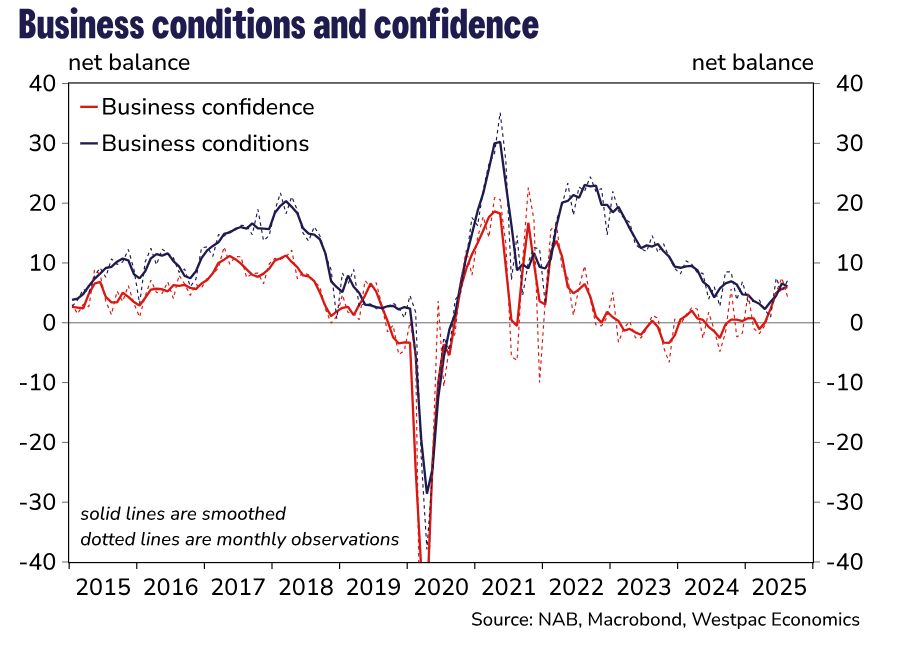
While conditions have trended up in recent months, business confidence slipped four points to four in August after hitting eight in July – the highest since 2022.
“We believe this drop suggests that businesses need to see further improvement in trading conditions before becoming more meaningfully optimistic,” Vanagas said. “This message from the business confidence index mirrors the evolving economic sentiment among consumers.”
The latest Westpac-MI Consumer Sentiment Survey underlined the uneven nature of the recovery. The index fell 3.1% in September to 95.4, with Westpac’s Matthew Hassan noting sentiment remains “firmly back in ‘cautiously pessimistic’ territory overall” despite recent RBA rate cuts, even as house price expectations surged to a 15-year high.
Elsewhere in the survey, firms reported slightly more willingness to spend, with the capital expenditure index rising to +10, the highest this year. Capacity utilisation was little changed, staying above its historical average.
Inflationary signals softened, with output, input, and labour cost indices easing from July. Output prices grew at a quarterly pace of 0.6%, consistent with annual inflation holding around the midpoint of the RBA’s target band.
Smirk added that while Westpac revised its September quarter trimmed mean forecast up to 0.7% q/q, “our end-2025 forecasts remain unchanged” as most of the lift reflects timing effects rather than a structural rise in inflation.
Get the hottest and freshest mortgage news delivered right into your inbox. Subscribe now to our FREE daily newsletter.