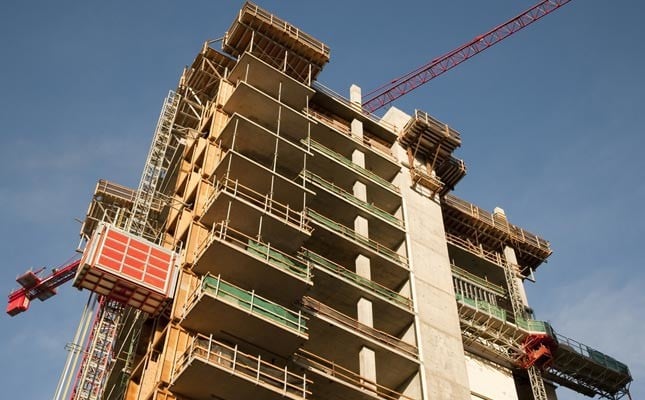
Australia's housing crisis has taken another turn for the worse.
Total dwelling approvals fell 10.5% to 17,300 in March, in seasonally-adjusted terms, the Australian Bureau of Statistics (ABS) revealed on Monday.
A slight uptick in February — driven by large apartment developments — did little to shift the broader trend: approvals remain far too low to meet demand.
That shortfall matters. Approvals are only the first step in boosting housing supply, and not all approved projects even reach completion. The result is a pipeline that continues to thin out before it even begins, intensifying pressure on an already strained housing market.
In March, private sector dwelling, excluding houses — that is apartments and units — fell 26% to 6,632, while private sector houses had a modest increase of 0.9% to 10,194.
Economists have long cautioned that non-house approvals are a volatile measure, often skewed by the timing of a single large apartment development in any given month.
"It's a really jumpy series [of data]," Dunk told Australian Broker. "Let's say a big apartment block gets approved. That adds a significant amount of building approvals that month. And if an apartment block doesn't [get approved] and it gets delayed to the next month or whatever, it might have bigger flow and effects later. Because of the number of apartments in a huge block."
In the past 12 months, 198,396 dwellings were approved in Australia, a 9% increase, year-over-year.
But Commonwealth Bank of America's (CBA) Associate Economist Lucinda Jerogin pointed out that: "Whilst total rolling annual approvals have lifted since mid‑2024, on a per capita basis, the picture remains softer. Approximately nine buildings were approved per 1,000 people in the year to March 2026. This is substantially lower than [approximately] 12 approved per 1,000 residents in early 2015."
Jerogin added that the cost of new homes is likely to rise again amid persistent inflationary pressures and global uncertainty, squeezing margins and making developers more likely to pull back.
"Headwinds to the construction sector are building under the weight of higher interest rates and higher costs due to the conflict and supply chain disruptions in the Middle East," the economist said. "We expect new dwelling cost inflation to pick up in coming months alongside announced construction material cost increases."
By state, the results were mixed in March. Total dwelling approvals dropped in Victoria (-16.9%), Western Australia (-15.5%), Queensland (-6.4%) and South Australia (-2.1%). New South Wales and Tasmania bucked the trend, with approvals rising 3.2% and 2.6%, respectively.
Meanwhile, private sector approvals told a slightly different story. They climbed in New South Wales (+9.5%) and Queensland (+7.2%), but fell in Western Australia (-8.6%), South Australia (-6.2%) and Victoria (-2.5%).
In broader terms, the slump in approvals spells trouble for an already strained housing market. In 2023, Prime Minister Anthony Albanese set an ambitious target of delivering 1.2 million new homes nationwide by 2029 under the National Housing Accord, a goal that looks increasingly out of reach as approvals continue to fall.