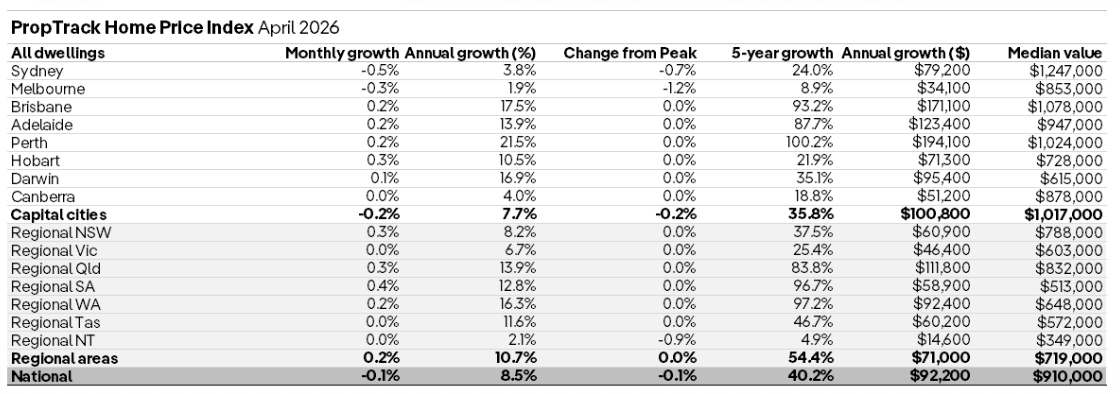
Australia’s national home prices fell 0.1% in April – the first monthly decline of 2026 – bringing the national median home value to $910,000, according to the PropTrack Home Price Index released on Friday.
Capital city prices dropped 0.2% over the month, with the median now at $1,017,000, though values remain 7.7% higher year-on-year. Price falls were concentrated in houses, with capital city house prices down 0.2%, while unit prices were flat.
Sydney recorded the steepest monthly decline among capital cities at -0.5%, followed by Melbourne at -0.3%. Both cities were the only capitals to post price falls in April.
In contrast, Hobart led monthly gains at 0.3%, followed by Brisbane, Adelaide, and Perth, each rising 0.2%. Perth remains the fastest-growing capital over the year at 21.5%, ahead of Brisbane (17.5%), Darwin (16.9%), and Adelaide (13.9%).
Regional markets continued to outperform the capitals, rising 0.2% in April and 10.7% year-on-year, compared with the capitals’ 7.7%.
REA Group senior economist Eleanor Creagh said the data pointed to a meaningful shift in the housing cycle.
“National home prices edged lower in April, suggesting a turning point in the housing cycle,” Creagh said. “Momentum has clearly slowed, marking a transition from broad-based growth to a more uneven, multi-speed phase.”
Creagh noted that auction clearance rates had softened, reflecting a growing gap between buyer and seller expectations, while higher interest rates were reducing borrowing capacity.
“While price growth is expected to slow, a large correction remains unlikely,” she added. “The adjustment is expected to be gradual, but slower growth and further price declines are likely.”
Ray White chief economist Nerida Conisbee echoed the cautious outlook, noting that open-for-inspection attendance across roughly 12,000 properties per week had declined from earlier in the year, indicating a more cautious buyer pool.
Despite the slowdown, both economists said structural supply pressures remain. Creagh pointed to population growth and ongoing supply constraints – exacerbated by higher construction costs – as continuing to place a floor under prices.
Conisbee warned that slower price growth would not resolve underlying affordability challenges.
“Without a meaningful increase in supply, affordability pressures are likely to persist – and may even worsen over time,” she said.