Despite a widely-anticipated rate hike from the Reserve Bank of Australia (RBA) Tuesday, the central bank's decision to raise the benchmark interest rate dampened sentiment, causing the ASX to close down.
The RBA increased the official cash rate (OCR) by 25 basis points — the third rate hike in 2026 — bringing interest rates to 4.35%. The move impacts mortgage holders and investors nationwide, many of whom are already struggling with rising living costs and persistent inflation.
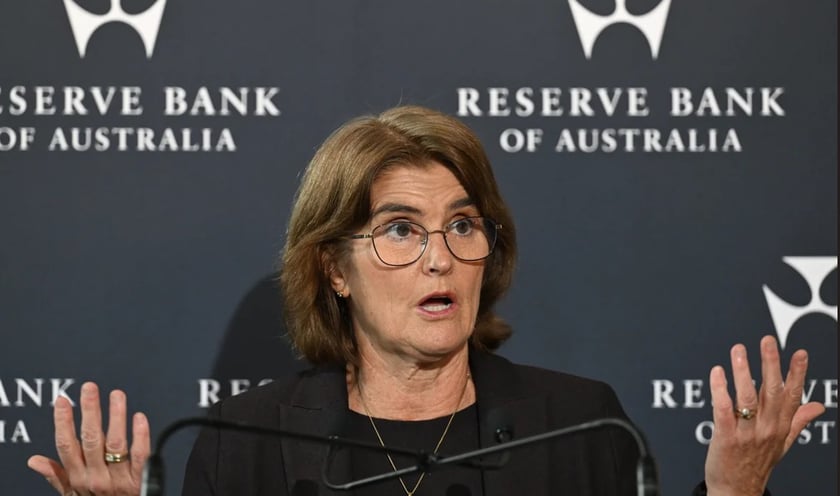
But during a press conference with the media Tuesday afternoon, RBA Governor Michele Bullock defended the bank's decision, making the case for the need for higher interest rates and repeatedly referencing the recent financial "shocks" from the conflict in the Middle East, including higher oil prices globally.
"Australians are poorer because of this shock to oil prices and energy prices and all the other commodity prices that are being impacted," Bullock said. "We are poorer, and there's no way out of that. The trade-off [for not raising rates] is much worse.
"These increases have been necessary to tighten financial conditions and slow growth in demand in the economy to ensure we get on top of inflation," she continued. "Inflation in Australia was already too high before the recent conflict in the Middle East began. The conflict adds to global and domestic inflation."
The most recent consumer price index (CPI), for the 12 months leading up to March, revealed that both headline CPI and trimmed mean inflation remain elevated and well above the RBA's target inflationary range of 2% to 3%. The war in the Middle East, which began in March, only add to price pressures.
Bullock was quick to point out that the recent rate hikes won't solve the domestic inflation problem anytime soon.
"What these increases do, however, is help to contain the domestic pressures [of] inflation due to oil and related commodity prices increases," she explained.
The governor added that the updated OCR is "a bit restrictive," noting that the board's stance was deliberate in order to curb spending and keep inflation in check.
"These interest rate rises aren't going to do anything for inflation in the next six months," Bullock said, adding that the higher rates give "the board space to see how the conflict plays out, and the response of Australian households and businesses to the shock."
Meanwhile, the RBA has forecast Australia's economic growth at a low 1.3%.
"That's pretty anemic growth," Bullock said. "It's not a good outcome for Australia. We are all feeling poorer. That's what this war has done, on the other side of the world."
The governor added that the RBA is anticipating inflation will likely peak in June. "It will then start to come down if oil prices start to decline," she said.
In regards to the extra burden placed on mortgage holders, Bullock acknowledged that "this is a really difficult time for households.
"But we must get on top of inflation now so that it doesn't get away from us," she said.
"Those households with mortgages and debt, yes, this is hurting them immensely," Bullock continued. "The thing is, and I've said this before, inflation is hurting everyone, including those people. So they've got a double whammy.
"It's tough. We're starting down the barrier. It's a very tough time," she added.
The latest rate rise comes amid a backdrop of surging living costs nationwide. At the same time, mortgage holders — and would-be homeowners — are contending with a chronic housing shortage that continues to drive prices higher and lock many out of the market.
Rising interest rates will no doubt have an impact on the property markets, particularly first-time homebuyers as higher rates erode borrowing power.
But Bullock argued that inflation is taking a bigger toll on the market, particularly in light of the "essential problem with supply."
"Building costs are such that you often hear from builders, particularly for high rises, that it's just not worth building, because they can't sell the properties for the cost it takes to build them," the governor said. "This is making [the housing shortage] worse.
"The only thing we can do is think more medium term and think about trying to bring inflation down so that we don't have high cost growth in the construction industry," Bullock continued. "That gives certainty to builders; that gives certainty to home buyers. That's something that we can offer in the medium term.
"But it's not something we can offer in the next 12 months," she added. "This is a shock completely out of our control. We already had a problem with inflation. This oil shock has complicated things immensely. The shock occurred at a time when inflation was already too high."